

Market Analysis
District 10 Landed Market Outlook 2026
Heading into 2026, District 10 landed housing is not one market. It is a collection of small enclaves — Namly, Lantana, Cypress and their neighbours — where transaction prices vary sharply even on the same street. The outlook is best read from the ground up.
By Taufiq Corvin · Published 23 October 2026 · Updated 23 October 2026
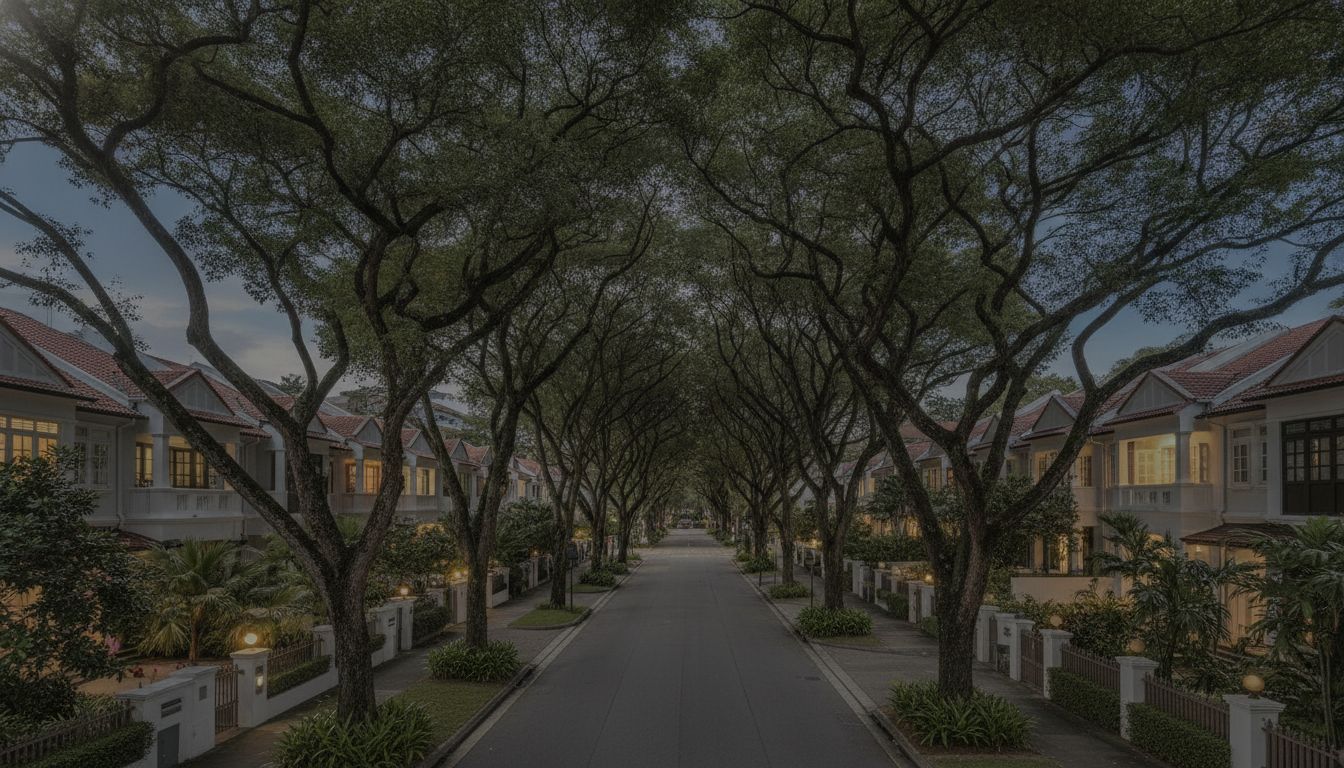
Every year, owners and buyers ask the same question: where is the District 10 landed market heading? The honest answer is that no single figure captures it. District-wide averages smooth over street-level differences that can mean millions of dollars. A more useful approach is to look at what actually traded, at what land PSF, and in which enclave — then ask what those transactions can and cannot prove.
What the 2025 transaction record shows
Between January 2025 and October 2026, 242 caveated landed transactions were recorded in Postal District 10. The breakdown is instructive: 149 transactions in 2025 (99 semi-detached, 37 detached, 13 terrace) and 93 transactions from January to October 2026 (48 semi-detached, 30 detached, 15 terrace).
Two things stand out. First, semi-detached houses dominate volume. They sit in the accessible middle of the landed market — larger than most terraces, more affordable than most detached houses, and well-suited to families upgrading from condominiums. Second, 2026 is on track to match or exceed 2025's transaction count in fewer months, which suggests continued liquidity rather than a frozen market.
But liquidity is not uniformity. Within the 28 sampled transactions on Namly-named streets, Lantana Avenue and Cypress Avenue, absolute prices range from $7.8 million to $13 million and land PSF ranges from roughly $2,158 to $3,140. That spread is the real story.
Enclave patterns: Namly, Lantana and Cypress
Each of the three focus enclaves carries a distinct buyer profile, and the transaction evidence reflects it.
Namly: walkability and village scale
Namly sits within walking distance of Sixth Avenue MRT, Guthrie House and the Namly Avenue shops. The street feel is more village-like, with narrower roads and more foot traffic. The buyer pool here often includes families leaving condos who still want daily convenience.
- April 2026: semi-detached, $8,800,000, 3,192.60 sq ft, $2,756 psf, freehold.
- September 2026: semi-detached, $11,400,000, 5,092.45 sq ft, $2,239 psf, freehold.
The September sale achieved a higher absolute price but a lower land PSF. The reason is visible in the land area: the later plot was roughly 60 percent larger. This is why headline prices alone can mislead.
Lantana Avenue: space and privacy
Lantana Avenue and the surrounding L-streets are quieter and more car-dependent. The plots are often regular and generous in depth, attracting buyers who prioritise privacy and garden space over train access.
- April 2025: semi-detached, $13,000,000, 5,012.79 sq ft, $2,593 psf, freehold.
- September 2025: semi-detached, $9,000,000, 3,065.59 sq ft, $2,936 psf, freehold.
- August 2026: semi-detached, $9,000,000, 4,171.05 sq ft, $2,158 psf, freehold.
Lantana recorded the highest absolute price in the sample at $13 million, yet also recorded a lower PSF on a larger 4,171 sq ft plot in 2026. The pattern is consistent: larger plots tend to trade at lower per-square-foot rates even when the total ticket is high.
Cypress Avenue: compact sites, higher PSF
Cypress Avenue offers proximity to King Albert Park MRT, the Rail Corridor and Beauty World amenities. The sampled plots are smaller, and the per-square-foot rates reflect that.
- October 2025: semi-detached, $7,800,000, 2,599.51 sq ft, $3,001 psf, freehold.
- July 2026: semi-detached, $8,200,000, 2,611.35 sq ft, $3,140 psf, freehold.
Cypress recorded the highest land PSF in the sample at $3,140 psf. The buyer here is often paying for accessibility and a manageable plot size rather than raw land area.
Source: URA private residential property transaction data, supplied CSV extract covering January 2025–October 2026. For a deeper comparison of these three enclaves, see Namly vs Lantana vs Cypress: Which Landed Location Fits Your Family?
What a transaction tells us — and what it cannot prove
A caveated transaction is a fact. It tells us that, on a specific date, a specific property changed hands at a specific price. Everything beyond that is interpretation.
What the record proves: the transacted price, date, land area, property type, tenure and address. In the Namly example, we can state with confidence that a freehold semi-detached house of roughly 3,193 sq ft sold for $8.8 million in April 2026, and that a freehold semi-detached house of roughly 5,092 sq ft sold for $11.4 million in September 2026.
What the record does not prove: why the buyer paid that amount, whether the house was move-in ready or slated for demolition, whether the seller was under pressure, or what the same buyer would pay for the house next door. URA records do not reveal renovation spend, defects, buyer-seller relationships, holding period or financing terms.
This distinction matters because the most common pricing mistake is to take a single transaction — usually the highest — and treat it as the new benchmark for every nearby home. That mistakes evidence for interpretation. A more reliable approach is to build a small set of comparables, score each one against land size, tenure, plot ratio, condition, orientation and frontage, and see where your home sits in the range.
For a fuller walkthrough of this method, see Why Two District 10 Landed Homes on the Same Street Can Sell for Very Different Prices.
Seller pricing mistakes to avoid
Heading into 2026, three pricing errors appear repeatedly:
- Anchoring on the highest headline price. A $13 million Lantana sale is real, but it reflects a 5,000 sq ft plot. A 3,000 sq ft home on the same street is not automatically worth 60 percent of that figure.
- Ignoring land PSF. Absolute prices rise with plot size; land PSF often falls. Buyers compare sites on a per-square-foot basis, and sellers should too.
- Confusing asking prices with transaction evidence. Asking prices reflect seller ambition; caveated prices reflect what a buyer actually paid. Only the latter should anchor a valuation.
If you are considering a sale, the seller advisory process starts with a street-level comparable set, not a district-wide average.
Rebuild, hold or sell?
The rebuild-versus-sale decision is shifting as construction costs, interest rates and planning rules evolve. Under URA Master Plan 2025, most District 10 landed zones retain their low-density character, but Development Control parameters still vary by street. A plot with favourable gross floor area, height envelope and setback can support a meaningful rebuild; a constrained plot may not justify the cost or timeline.
The question is not whether rebuilding is possible. It is whether the rebuild adds more value than selling the site as-is and redeploying the capital elsewhere. Owners should weigh:
- The physical condition of the existing house and the cost of making it liveable.
- The allowable plot ratio and gross floor area under current guidelines.
- The family's holding period and whether the new home will be lived in or sold.
- The risk of cost overruns, approval delays and contractor availability.
For a structured framework, see Rebuild, Renovate or Sell Your District 10 Landed Home?
District 10 in 2026: the synthesis
The broader District 10 landscape remains one of Singapore's most established landed corridors, but the headline is resilience rather than uniformity. Transaction volume has held up. Semi-detached homes continue to absorb most demand. Prices vary sharply by enclave and plot size. And the buyers who matter are not buying a district — they are buying a specific street, a specific plot and a specific set of trade-offs between convenience, privacy and rebuild potential.
Within this landscape, Namly, Lantana and Cypress each serve a different buyer segment. Namly suits families who want walkability. Lantana suits buyers who want space and quiet. Cypress suits buyers who want compact accessibility near green corridors. None is objectively superior; each is superior for a specific objective.
The 2026 outlook, therefore, is less about predicting price direction and more about understanding segmentation. Owners who price with street-level evidence will find buyers. Buyers who compare land PSF rather than headline price will understand value. And everyone who treats a transaction as evidence rather than verdict will make fewer expensive mistakes.
The Corvin Perspective
In District 10, the most dangerous price is the one you remember without its context. A neighbour's sale is evidence, not a verdict. The real work is understanding whether your home is comparable in the dimensions that matter to the next buyer.
Frequently asked questions
What is the current state of the District 10 landed housing market?
District 10 landed housing remains active but segmented. Between January 2025 and October 2026, 242 caveated landed transactions were recorded in Postal District 10. Activity is concentrated in semi-detached homes, with meaningful price dispersion between enclaves driven by plot size, tenure and street character.
Which District 10 enclave has the highest land PSF?
In the sampled transactions, Cypress Avenue recorded the highest land PSF at $3,140 psf in July 2026, on a compact 2,611 sq ft semi-detached plot. Smaller plots in walkable locations tend to trade at higher per-square-foot rates than larger, quieter sites.
Can I use my neighbour's sale price as my asking benchmark?
Only as a starting point. You must adjust for land area, tenure, plot ratio, built condition, orientation, frontage and whether the buyer was an owner-occupier or developer. A headline price without context often misleads more than it guides.
Should I rebuild, renovate or sell my District 10 landed home?
The right path depends on your holding period, the plot's allowable gross floor area, the physical condition of the house, construction-cost tolerance and your family's lifestyle needs. A plot with favourable zoning and a tired structure often favours rebuild; a recently updated home on a constrained site may favour sale.
Planning your next move in District 10?
For a conversation about how your street, plot and objectives fit into the 2026 market, start with a clear comparable analysis.
Discuss your situationRelated reading
Namly vs Lantana vs Cypress: Which Landed Location Fits Your Family?
A street-level comparison of three District 10 enclaves using transaction data and practical family-buyer criteria.
Why Two District 10 Landed Homes on the Same Street Can Sell for Very Different Prices
How to read a neighbour's sale without overpricing your home or dismissing a genuine market signal.
Rebuild, Renovate or Sell Your District 10 Landed Home?
A practical decision guide for owners weighing renovation, rebuilding or sale.
Sources and verification
The transaction figures cited in this article were extracted from a URA private residential property transaction data CSV supplied to Corvin Homes, covering the period January 2025 to October 2026. The figures were cross-checked for address, transaction date, property type, land area, transacted price and tenure before publication.
Additional context was drawn from the following public sources:
- Urban Redevelopment Authority (URA): Master Plan 2025, Development Control parameters and landed housing guidelines.
- Singapore Land Authority (SLA): land tenure, title information and land area records.
- Inland Revenue Authority of Singapore (IRAS): stamp duty and property tax guidance.
- Building and Construction Authority (BCA): gross floor area definitions and building control standards.
- Council for Estate Agencies (CEA): practice guidelines for property agency work and transaction data.
Land PSF figures are rounded to the nearest dollar. Calculations are based on the verified transacted price and land area supplied in the URA dataset.
About the author
Taufiq Corvin is a real estate salesperson with Huttons Asia Pte Ltd (CEA Registration R060478C). He advises owners and buyers of landed homes in District 10, with a focus on Namly, Lantana, Cypress and surrounding streets.
Updated 23 October 2026
